



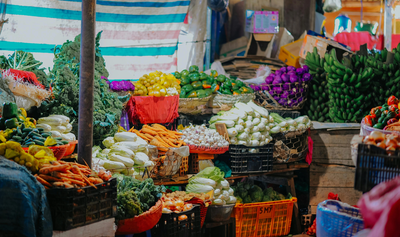


Romania has one of the lowest fruit and vegetable consumption rates in the European Union, as almost 75% of Romanians do not consume even one serving of vegetables or fruit per day, according to Eurostat data processed by the Social Monitor, a project of the Friedrich-Ebert-Stiftung Romania (FES), inform Agerpres.
As many as 24% of the respondents said they eat between one and four servings daily and only 2.4% of Romanians consume five servings of vegetables and fruit per day, as recommended by the World Health Organization.
At the same time, although Romania has 8.1% of the arable land used in the EU and 4.2% of the Union's population, it contributes only 1.9% to the annual production of fresh vegetables and 5.4% to the production of fruit, which fuels dependence on imports and higher prices for low-income consumers, informs the same source.
"Romania's situation contrasts sharply with the EU27 average, where only 33% of Europeans do not consume any portion of vegetables and fruits per day, while 55% consume between one and four portions, and 12% reach five or more portions per day. Even in the Central and Eastern Europe, Romania lags far behind countries such as the Czech Republic, Poland or Bulgaria in terms of fruit and vegetable consumption. This reality configures a vicious circle: insufficient production compared to land resources, dependence on imports, higher prices on the shelf and, ultimately, reduced consumption," a press release from the FES states.
The distribution of agricultural land would, in theory, allow covering a significant part of the domestic need for fruit and vegetables. The EU27 states have a total of 157 million hectares of used agricultural land, of which 12.8 million hectares of agricultural land are used in Romania, which represents approximately 8.1% of the total.


According to the researchers, despite using 8.1% of the agricultural land in the European Union, Romania produces well below potential in the vegetable category (1.9% of EU production) and only marginally better in fruit production (5.4%). Overall, the level of production in Romania remains below the potential that its share of agricultural land would suggest and well below the potential of other countries in the region, such as Poland, which produces 16% of the fruit and 8% of the vegetables grown in the EU27 with only 9% of the agricultural land used. This underproduction perpetuates pressure on imports and keeps national consumption at very low levels, the same source emphasises.
In this context, the impact on public health and the economy is major, as low consumption rates correlate with increased risks for non-communicable diseases and decreased productivity. The World Health Organization recommends at least 400 g of fruits and vegetables per day, the equivalent of five servings, and Romania today has the lowest share of population that reaches this target among the mentioned European states.






























Comentează