



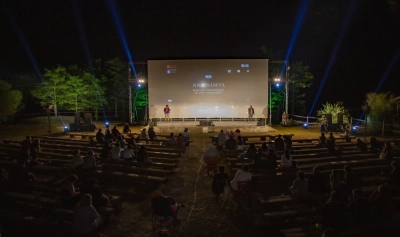


Romania will open this year's edition of the European Film Festival in Vienna with the film called "The Year That Never Came" ("Anul Nou care n-a fost"), directed by filmmaker Bogdan Muresanu, according to a Romanian Embassy in Austria press release sent to AGERPRES on Thursday.
The event will take place on 19 February at 20:00 local time at the Stadtkino Wien cinema. The screening will be followed by a question and answer session with director Bogdan Muresanu.
Since its world premiere within the 81st Venice International Film Festival, "The New Year That Never Came" has had a remarkable run, winning the prestigious Orizzonti Award for Best Film, as well as the FIPRESCI Prize at the Venice Film Festival. It continued its success nationally by dominating the 2025 Gopo Awards, where it won Best Feature Film, Best Director, Best Screenplay, Best Lead Actor and Best Lead Actress, as well as Best Debut Film. On the international festival circuit, the film also won the Grand Prix at the Luxembourg City Film Festival 2025 and the Golden Pyramid Award at the 2024 Cairo International Film Festival.
The cast of the film includes actors Adrian Vancica, Nicoleta Hancu, Emilia Dobrin, Iulian Postelnicu, Mihai Calin, Andrei Miercure, Manuela Harabor, Elvira Deatcu and Ada Gales.
The 2026 Vienna European Film Festival will take place in the Austrian capital from 19 to 26 February.
This year, the European cinema will once again have a prominent platform in Vienna: during the aforementioned period, the network of national cultural institutes and European Union embassies, European Union National Institutes for Culture (EUNIC) in Austria, will organise the European Film Festival in the Austrian capital for the second time.
At the Stadtkino Wien, 18 countries will present their latest film productions, showcasing both a wide range of artistic activity and a perspective on Europe's past, present and future.
The European Film Festival, like the EUNIC Austria, promotes cultural diversity and understanding, particularly through the presentation of a various and stimulating selection of the most interesting, significant and valuable films from each participating country.

The films aim to stimulate debate and discussion, to engage both occasional viewers and passionate film fans, and to celebrate this art form in a friendly, non-competitive environment. These films do not provide answers or false certainties, but help people, both individually and collectively, to formulate questions and understand them better. In a time of change and uncertainty, they offer an opportunity to reflect together, to examine where humanity stands, how it has arrived here, and the directions society might take in the future.















Comentează