



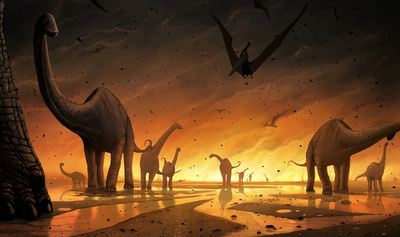


The journal Nature published on January 7 a study carried out by a team of researchers coordinated by Prof. Susannah Maidment of the Natural History Museum in London, together with specialists from leading research institutions in the United Kingdom, Hungary, Germany and Romania, and which rewrites the history of ceratopsians - the "horned dinosaurs" of the Late Cretaceous.
Assoc. Prof. Dr. Zoltan Csiki-Sava, researcher and lecturer at the Faculty of Geology and Geophysics of the University of Bucharest, was part of the team of experts who solved the puzzle of Europe's missing horned dinosaurs, revealing that some rhabdodontid dinosaurs, a poorly understood group thought to be relatives of Iguanodon and found only in Europe, are in fact ceratopsians.
Some of the fossils that provide the evidence for the new study were discovered in the Hateg Country UNESCO Global Geopark, managed by the University of Bucharest, the University said in a release.
The study overturns a century-old assumption that ceratopsians, known for their distinctive cranial ornaments, never reached Europe, the cited source shows. The new investigations indicate that the European Cretaceous fauna was much more diverse than previously thought, and fossils from Romania and Hungary provide evidence that ceratopsian dinosaurs were present in the region and produced distinctive island adaptations. These findings offer a new perspective on how the European continent functioned in the geological past as a space of evolution and interconnection for different groups of dinosaurs.
"These results fundamentally change the way we understand the evolution of the Cretaceous fauna in Europe. The fossils discovered, including those from the Hateg Country UNESCO Global Geopark, show that not only did ceratopsian dinosaurs reach the former European archipelago, but they also evolved their own forms here, adapted to the island environment. Our studies show that fossils previously considered as rhabdodontids - a group recognized as endemic to Europe - actually belong to atypical 'horned dinosaurs', and Europe could even have represented an important corridor in the spreading of these animals between Asia and North America," Professor Dr. Zoltan Csiki-Sava argued, as cited in the release.
The fossils found in the Hateg Country UNESCO Global Geopark, one of the world's most valuable paleontological regions, played an important role in this discovery. Based on materials from the Sinpetru Formation located in the south of the Hateg Basin, the researchers defined a new genus of primitive ceratopsian, Ferenceratops shqiperorum. "Its name honors the contribution of Baron Franz (Ferenc) Nopcsa, a pioneer of paleontological research in Hateg Country and one of the most influential paleontologists of the early 20th century. Nopcsa is also the one who discovered the fossil material that today represents the reference specimen of the species (the holotype)," the University of Bucharest release states.

The results of the study of the Romanian fossils complement data provided by recent major discoveries from the Upper Cretaceous in Hungary, where much more complete cranial elements belonging to Ajkaceratops kozmai - a 'horned dinosaur' with affinities disputed until recently - were identified. The newly discovered skull remains also unequivocally confirm the belonging of this species to the ceratopsian group.
"The interpretation of the discoveries from Romania and Hungary confirms both the importance of international collaboration in paleontological research and the essential role of the Hateg Country in reconstructing the evolution of the European Cretaceous fauna. This study opens new research directions and strengthens the position of the Hateg Country UNESCO International Geopark, part of the heritage of the University of Bucharest, as a scientific landmark at a global level. The significance of this discovery is further increased by the fact that even some materials previously attributed to the herbivorous dinosaur Zalmoxes display ceratopsian features, which suggests that the identity and diversity of herbivorous dinosaurs from the Hateg Basin will have to be substantially reconsidered," the release states.


























Comentează