



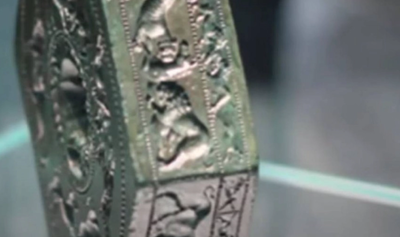


The Cris Land Museum in Oradea has selected the Suplacu de Barcau clay tablet as its January 'Exhibit of the Month'. The artifact, part of the Archaeology and Restoration Section's Treasure category, is one of the few tablets discovered in Romania apart from the better-known Tartaria tablets.
"You are aware of debates around the Tartaria tablets, which some argue represent the earliest signs of writing, predating Sumer. In this context, artifacts such as the one from Suplacu de Barcau were found in southeastern Europe. They are not interpreted as writing but as ideograms - symbols that convey meaning by common agreement within a community, much like traffic signs," Gruia Fazecas, head of the museum's Archaeology and Restoration Section, told AGERPRES on Wednesday.
The Suplacu tablet, dating to 4850 - 4800 BC, is a fragmentary clay disk about 6 cm in diameter and 6 mm thick, made of fine paste with mud as a binder. Burned to a brick-red color with light gray spots, it features incised semicircles filled with dots and human figures in prayer poses. Experts believe these motifs connect the piece to late Neolithic religious practices in northwestern Romania.
Fazecas noted that while some researchers dismiss the tablet as a pendant, its repeated "orant" figures and unique ornamentation suggest a ritual function. "The piece encodes and transmits a message, but it does not constitute writing. Its value lies in its uniqueness, which places it in the Treasure category," he specified for AGERPRES.
The public can view the artifact between January 15 - 31 at the Oradea City Museum's Griffin Hall.
The Cris Land Museum will continue the 'Exhibit of the Month' project in February, showcasing exceptional items from its collections that are not part of the permanent display. According to museum director Gabriel Moisa, only about 10% of the institution's heritage is on view at any given time.

Thus, each month, visitors are introduced to an exceptional item from the museum's collections, whether it is an emblematic exhibit in the field of natural sciences, a unique archaeological discovery, a resonant historical exhibit, a work of art with a fascinating story or a rare ethnographic piece.
In November, the project featured the Manopan Organette, Model V, Excelsior, a mechanical musical instrument made at the "Euphonika" Musical Instrument Factory in Leipzig in 1895 - 1896 and classified in the Treasure category. The instrument, which uses recordings on perforated cardboard or metal tapes, 16.5 cm wide, entered the museum's collection in 1982. The device served secular, entertainment purposes for at home or at more modest venues.





























Comentează