



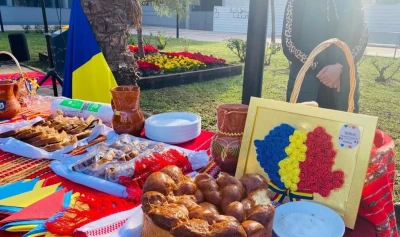


Located about 45 kilometres from Piatra-Neamt and just eight kilometres from Roman, the village of Trifesti is already recognised both within the county and nationwide as a guardian of local traditions, Agerpres reports.
We found the "Sumanarii" of the commune rehearsing intensely at the local cultural centre, far from the urban bustle of preparing festive meals for the winter holidays.
The drum beats, the Romanian friction drum (buhai) roars, the traditional alpine horn (bucium) can be heard, while the traditional New Year's chant (uratura) flows on, accompanied by whips and jingling bells.
The boots of the "sumanari" - traditional performers wearing suman (sheepskin) cloaks - are polished, and their garments gleam in the vivid colours of Romanian folk costume.
They are once again invited to customs and traditions festivals held during this period, and they take their role seriously.
Moreover, in keeping with a tradition they have faithfully preserved for over 50 years, on New Year's Eve they must go from gate to gate throughout the village.
Founded in the early 1970s, the folk ensemble "Sumanarii din Trifesti" has become a cultural brand of the county, taking part in all major folklore festivals in Romania and abroad.
We learned from the director of the Trifesti Cultural Centre, who has overseen the ensemble's activities for over 20 years, why they are called "Sumanarii" and what makes them distinctive.
"This ensemble is in fact the Ploughing Song (Plugusor) Procession. All members wear traditional suman coats, hand-woven in the village. These coats are over 100 years old, and their patterns are unique, specific to the area. The members of the ensemble are deeply passionate and truly love traditions," said Elena Vasilica Popa, director of the Trifesti Cultural Centre.

As our interview unfolds, the "Sumanarii" spare none of their instruments, and the voices of the carollers carry, unamplified, beyond the walls of the centre.
That is how it must be, because people need to hear them from afar in order to open their gates wide to receive the carol - otherwise...
"The Sumanarii of Trifesti do not just have a story, they have a tradition: the suman coats are made of wool, and wool symbolises respect and purity. They proudly wear the coat and go carolling through the village. If your gate is closed and you do not receive the Sumanarii, it means you had a bad year and have nothing to put on the table for them. That is why, on the night of 31 December to 1 January, all householders in Trifesti keep their gates open for the Sumanarii," recounted Neamt County Council vice-president Mihaela Isciuc, a native of Trifesti.
A well-deserved break in rehearsals follows, giving us time to learn some behind-the-scenes details from the ensemble's leader.
Gelica Morosanu has been a "Sumanar" for 25 years and has led the group for 15.
":I have been part of this ensemble since 2000, and for about 15 years I have been its coordinator. I had uncles, grandparents and relatives in this ensemble who, unfortunately, are no longer with us, and I carry the tradition forward. We perform a traditional carol with a message about ploughing, sowing, harvesting, milling grain and baking bread. We sing about the year that has passed and send a message of hope that the coming year will be better than the one ending. The costumes we wear were made by a local craftsman over 100 years ago, a craftsman who took the secret of making them with him," says Gelica Morosanu.
But it is not only the costumes that tell an old story, but also the instruments that are an integral part of the carol.
"As props, we have the buhai, whips, a collar with bells, the horn, the alpine horn and the drum. The buhai and the horn are over 60 years old, inherited from father to son,' says Gelica Morosanu with pride.
Time passes inexorably and rehearsals must resume, so our brief interview comes to an end.
Gelica Morosanu quickly pulls his cap over his head and calls the ensemble to order.
The "Sumanarii" line up swiftly, the buhai roars again, whips crack, and bells and horns accompany the carol.
They cannot afford to disappoint, especially as they have won first prize at every competition they have entered.
They must succeed this time as well, particularly since their carol always brings hope for the coming year - hope awaited by all Romanians.























Comentează