




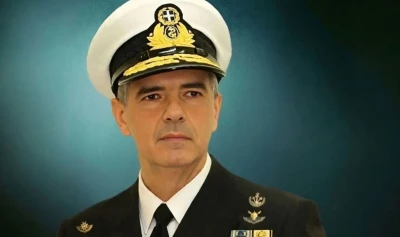


An interview conducted by Dr. Adrian Leonard Mociulschi
The future of naval power may depend as much on algorithms and autonomous systems as on ships and sailors. The question is not whether technology will transform naval warfare, but whether it will replace traditional naval forces or simply reshape them.
In this exclusive interview for STIRIPESURSE.RO, Vice Admiral (Ret.) Dimitrios Kavoulakos of the Hellenic Navy discusses the future of naval power, the strategic dynamics of the Black Sea and the Eastern Mediterranean, and the growing role of Artificial Intelligence and autonomous systems in maritime warfare.
Adrian Leonard Mociulschi: Vice Admiral, welcome, and thank you for taking the time to speak with us.
In your view, what role should frigates, corvettes, and offshore patrol vessels play in protecting national maritime interests in strategic regions such as the Eastern Mediterranean and the Black Sea?
Vice Admiral (Ret.) Dimitrios Kavoulakos: The suitable role stems from the nature of naval vessels. Their sensors are the State's eyes and ears in the maritime area of interest, and their weapons and effectors are the means to enforce the State's will and protect national interests at sea or in coastal areas. In reality, they create the nation's awareness and project its power at sea within the range of their sensors, weapons, and organic assets.
As with every government requirement, resources are always less than needs, and even in nations with navy-centered budgets, force planners constantly seek the most suitable force structure within available resources. They must determine which types of ships are best suited for required missions, how many are needed, which systems and weapons they should carry, and whether the country can acquire, support, maintain, modernize, and crew them over the long term.
The roles, missions, and tasks of a naval force derive from national strategy, geography, and the capabilities of potential threats. Regions such as the Eastern Mediterranean, from Sicily to Lebanon, and the Black Sea are highly congested and contested. While a certain balance currently exists among the various actors operating there, that equilibrium remains fragile.


The value of these regions to global trade, economic activity, and strategic interests is exceptionally high. Coastal states must therefore be able to guarantee, or contribute to, the safety, security, and accessibility of maritime trade routes while safeguarding their own national interests, whether acting independently or as part of alliances and international organizations.
Adrian Leonard Mociulschi: You argue that naval planners must constantly match capabilities to missions while operating under resource constraints. Against that backdrop, let us turn to a category of vessels that has attracted growing attention in recent years.
How can light corvettes contribute to coastal defense and maritime security in an era marked by rising geopolitical tensions and increasingly complex threats at sea?
Vice Admiral (Ret.) Kavoulakos: Disruption, attrition, and denial are often the strategies of choice for countries or actors that cannot, or do not wish to, engage in a conventional naval confrontation. Contrary to a traditional sea battle, disruption, attrition or denial are constant and longer duration operations that can, in the longer term, afflict damage to a nation’s economic life, naval assets, reliability, international status and national interests. In such a confrontation, the "economics" of warfare demand that national interests are protected and objectives achieved, while high-end and costly assets are not committed to grueling confrontations in which the opponent has far less to lose and which deprive those assets of missions that only they can perform, such as sea control.
This is why it is important for a Naval Force to include lighter ships that can among other tasks perform long term surveillance, patrols, sea lane protection, naval presence or ASW in coastal or brown waters, or special ops support etc. The fact that those ships are lighter does not mean that they necessarily have a lighter “sting”. In general, when talking about a light frigate or corvette, they can be capable of operating across three domains (surface, anti-air, and subsurface warfare), but due to limitations in size they may face constraints in ammunition capacity, sensor range, weapon range, endurance, and operational reach. In many cases they can carry the same main gun, torpedoes, surface-to-surface missiles, helicopters, or self-protection surface-to-air missile systems as larger units. Even OPVs, which are not expected to perform AAW or ASW operations, can in many cases be fitted with, or prepared for, naval guns or surface-to-surface missiles.
We should always keep in mind that in naval warfare, size matters and that every choice, large or small, simple or sophisticated, comes with trade-offs if not properly balanced. Smaller ships can perform tasks to relieve or assist major naval units such as frigates and destroyers. The former are less demanding in crew or maintenance, however, limited autonomy, reduced capability to participate in high-intensity warfare, reduced ability to operate in rough weather, vulnerability to air threats, and vulnerability to submarines are among their weaknesses. They can be formidable opponents near the coast as geography may protect them, but they are no match for a naval force of frigates and destroyers in the open sea or when coastal areas are isolated by an enemy. A good example would be lighter ships extending the surface surveillance horizon or conducting ASW operations under the AAW umbrella provided by frigates or destroyers.
When we view a ship as part of a Naval Force, not as a separate item, we understand that we do not examine it only as a unit but as a contribution to the whole Naval Force Posture, Capability and Capacity as well. Deployed i.e. in coastal areas smaller ships are ideal pickets or sentries that enhance the overall maritime domain awareness horizon or fire projection envelope of a larger force. Individually they can provide protection to maritime shipping, economic zones, environmentally sensitive areas, or valuable infrastructure against asymmetric threats or violation of the law, freeing resources and larger ships to combat high-end threats.
Adrian Leonard Mociulschi: If previous generations of naval planners focused on balancing ships, weapons, and manpower, the next may increasingly be shaped by Artificial Intelligence and autonomous systems.
Looking ahead, how do you see these emerging technologies influencing the future of naval operations?
Vice Admiral (Ret.) Kavoulakos: Looking ahead, I do not believe that emerging technologies will overturn the fundamental principles of naval warfare. The same considerations that shape naval platforms today, namely size, capability, capacity, simplicity, value, sophistication, and complementarity, will also shape the development and employment of autonomous systems. In my opinion, unmanned systems should be treated as components or assets of a naval force, or of an individual ship, rather than as substitutes, particularly at sea, where missions are often prolonged and conducted far from shore-based Remote Operation Centres.
The absence of a crew increases payload options while reducing the impact of loss of life, crew fatigue, and single-task duration constraints.
A naval UAS can operate without being constrained by crew fatigue resulting from weather conditions or mission intensity, even though until now and for the foreseeable future, there is a crew, whose fatigue must be considered and must be replaced in round the clock operations, only not on board the unmanned system.
The general belief is that unmanned and autonomous systems of any size are the future. Even though they offer significant advantages, they also come with important limitations, as is the case with every technological advance. These limitations deserve careful consideration.
Adrian Leonard Mociulschi: You have emphasized that every technological advance brings not only new capabilities, but also new constraints.
Looking beyond the potential benefits, what do you consider to be the principal technical and operational limitations of autonomous and unmanned maritime systems?
Vice Admiral (Ret.) Kavoulakos: To understand the limitations of autonomous and unmanned systems, we must first clarify what the term "autonomous" actually means. Despite the common perception that autonomous systems are platforms that can simply be launched and forgotten until mission completion, this is neither the general case nor the rule. Autonomy encompasses different levels of human oversight and interaction. A remotely operated system represents the first level of autonomy, whereas a fully autonomous system operates largely on its own within predefined mission parameters.
In any case either for remote operation or for mission oversight, as mission parameters can change, there is always going to be a command-control link among mission control with humans in charge, the unmanned system and other actors in a mission, manned or unmanned. This control or oversight link is the first major limitation in deploying an unmanned system. The main concerns are range, bandwidth, redundancy, and what happens if the primary link is lost. A complex mission, such as that of an unmanned OPV, needs substantial bandwidth, so that the appropriate information and commands are exchanged between participating units and the Command Station. A suicide USV like the Ukrainian Maguras even though they can be devastating to the enemy can be supported by a satellite link or cell network.
A second concern comes with a regular, and vital function, in the mode of operation of manned ships, damage control, maintenance and repair. Suicide USVs are not complicated or so expensive to raise concerns about machinery malfunction, repair and maintenance. However, with larger USVs as an OPV or bigger, the question that arises is, what will happen if one engine shuts down, a sensor like a camera or a radar does not work, communication is lost, temperatures are high in the ammunition storage etc.
There is no onboard crew for repairs. As a result, the more important an unmanned system is for a mission, the more likely it is that another manned ship, equipped with the personnel and equipment needed to control, support, supply, board, and repair it, will be deployed nearby, acting as a tether. As unmanned ships continue to become larger and more complex, the issue of reliable systems and machinery with little, and preferably no, need for maintenance and repair during a mission will become a major factor. However, machinery and systems tend to eventually malfunction or fail, and often this happens at the most inconvenient moment.
Adrian Leonard Mociulschi: Beyond the technical limitations you have described, there are also important questions of responsibility and human oversight.
What challenges do Artificial Intelligence and fully autonomous naval systems raise in terms of accountability, decision-making, legal responsibility, and the future balance between manned and unmanned naval forces?
Vice Admiral (Ret.) Kavoulakos: Beyond the technical challenges already discussed, fully autonomous systems also raise fundamental questions of oversight, accountability, and redundancy. In a system controlled exclusively by Artificial Intelligence, who is responsible if something goes wrong or if the AI takes a command decision that later proves incorrect, particularly when there is no human on board to intervene, as would be the case on a manned vessel? What happens if an unmanned ship is hacked and taken under the control of an adversary? How can we know in advance that a dangerous situation is developing or that a catastrophe is imminent?
A first thought is that there are always safety protocols; however, in the case of a distant unmanned warship, the issue is not the existence of protocols but how they are to be applied in practice. For example, navigational mistakes resulting from sensor failures that can lead to naval accidents, or blue-on-blue engagements during real time operations, or wrong command decisions. Bearing in mind that navies operate extensively in peacetime, if an unmanned warship, through its own error, collides with a merchant vessel, who will appear before a court and be responsible for compensation?
In the civil/commercial world, the leading authority to establish rules with respect to autonomous shipping is the International Maritime Organisation. The IMO recently finalized a non-mandatory set of regulations, which, after a few years and substantial feedback from the maritime sector, are expected to be expanded and eventually become mandatory. The core elements of the IMO framework are human accountability and oversight, as if the ship’s master and crew were onboard, reliable machinery, and the capabilities and capacity of Remote Operation Centres.
Adrian Leonard Mociulschi: As we reach the conclusion of this interview, let me ask a final question.
Do you believe the future belongs to fully unmanned fleets, or to hybrid naval forces that integrate Artificial Intelligence and unmanned systems alongside traditional manned warships?
Vice Admiral (Ret.) Kavoulakos: Before discussing whether the future belongs to fully unmanned fleets or hybrid naval forces, it is useful to consider the experience gained in the air domain. Yet any assumption that solutions successful in aviation can be transferred directly to the maritime environment would be misleading. While some principles are applicable, the operational realities of the sea remain fundamentally different. For example, UAVs are remotely piloted as if a pilot were onboard, a model that has worked remarkably well and naturally prompts the question: why not at sea?
Yet, flights mostly last a few hours while ships are deployed for months and weeks, and the crew of a plane is much smaller than the size of a ship's crew or the watch teams at the bridge, the operations centre and propulsion and machinery control centre. Furthermore, the information a ship must process, both internal and external, for safe and effective operation is far greater than that required by a UAV.
Having established that we are still far from unmanned navies or fully unmanned fleets, we cannot ignore the various breakthroughs of new technologies and their integration into naval warfare, which means warships and fleets that combine the best of the two worlds. Manned naval ships will be built to carry organic Unmanned Vehicles, surface, aerial or underwater, in addition to their standard payload. Organic Unmanned Vehicles will come with requirements for Command and Control, mission bays, launch and recovery systems, onboard control centres or positions in the ship’s operation centre, maintenance capabilities, ammunition storage and consequently the appropriate personnel for such demands, in addition to the ship’s main crew.
In parallel ships will not be deprived of manned organic assets as Helicopters or Special Forces boats. In addition, as now drones are included in the threats a ship can face, anti-drone systems and weapons, will be added to a ship's payload. Furthermore, a manned naval unit will be used to tether a network of unmanned vessels, tightly or loosely. AI will be used on board a ship, or command centre, to support humans in handling the additional complexity and volume of future naval warfare.
As a result, the introduction of unmanned vehicles and AI in naval operations will not erase manned warships from a naval force, or decrease their importance, quite the contrary, it will affect their size and capabilities and, despite current perceptions, manned naval ships will become larger and more capable.
Adrian Leonard Mociulschi: Vice Admiral, thank you for joining us and for sharing your insights on the future of naval power, maritime security, and the challenges posed by emerging technologies. It has been a privilege to speak with you.
Beyond Automation
The history of technology is filled with predictions of replacement. Yet the more powerful our tools become, the more visible the question of responsibility becomes.
In an age increasingly shaped by algorithms, the central challenge is not whether machines can act, but whether humans remain willing to assume responsibility for the consequences. The future may belong neither to sailors nor to software alone, but to the space where judgment and technology continue to meet.
An interview conducted by Dr. Adrian Leonard Mociulschi




























Comentează