



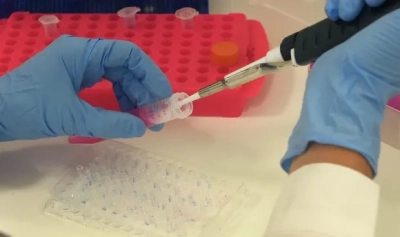


Research should be in style and young people should follow the path of science, believes Dr. Eng. Bianca Musat, a specialist at the Buzau Plant Genetic Resources Bank (BRGV).
The career of a researcher often starts in school, where students prepare themselves early on, accumulating the notions of exact sciences. Mathematics, chemistry, physics and biology are the basic subjects through which young people gradually enter the university environment and then prepare for the scientific world. Bianca Musat, one of the seven specialists who form the BRGV research team, discovered her passion for science as a student in the Philology department.
"I wanted something different from all my colleagues. I wanted to get into a niche, I didn't know exactly where I was going. I graduated from 'Mihai Eminescu' College, Philology section, I had no practical connection with biology, with the world of plants. I wanted something practical, a university that would give me a profession. It seemed much more practical and relevant and so I chose the Faculty of Horticulture, pushed by my father who told me to go towards this world that pleases our eyes and, why not, from which we live and which brings us health. It is an extraordinary faculty, which reveals the secrets of the universe and you understand that all forms of life - man, animal, plant - are subject to the same laws, it is so simple and in fact we complicate everything," Bianca Musat told AGERPRES.
After completing her undergraduate studies at the Faculty of Horticulture of the University of Agronomic Sciences and Veterinary Medicine (USAMV) Bucharest, the young researcher received support from a mentor, in order to enter the world of science more easily.
"We are talking about the year 2011 when I entered into research alongside Dr. Eng. Costel Vinatoru, who is still my mentor today. I had no experience, I liked this idea, I loved plants from all points of view, from all adjacent fields, I mean vegetable growing, floriculture, ornamental flowers. If you don't have a research mentor, it's hard in Romania, because it's an environment where everyone does his own work, but young researchers are not really involved in certain projects, it's very hard to get into this field. It's the lack of confidence, the lack of experience, plus there is the secret of research. There are collections of plants that you can't leave to just anyone. If we're talking about tomatoes, we have over 5,000, even 6,000 varieties. If we get a line code wrong, that means 40 years of research are gone," reveals Bianca Musat.
Shortly after graduation, the first career problems arose, as well as those related to the financial and working conditions. Paradoxically, the situations encountered produced the biggest change in the young woman's career, moving from the Vegetable Research and Development Station Buzau (SCDL) to BRGV.


"My first contact with research was the contest I took at SCDL Buzau, which I won. I was then called to work where I was faced with financial problems. Salaries were low, plus the lack of adequate equipment. At the USAMV I practiced with equipment, here everything was limited to a ruler and a pencil and it was very difficult. However, research was done and I'm glad that I found it hard because that's what really shaped me. I trained from the ground up, from the field, from the root of the plant. We didn't have storage spaces for the thousands of species and then Dr. Engineer Vinatoru came up with the idea of a genebank for plant genetic resources, which I immediately embraced. I put all my effort into the whole process of setting up the genebank. Now I can't believe that my dream has somehow come true," says the researcher from Buzoa.
The intense activity in the service of research, together with her colleagues, was crowned by the printing of the first treatise on vegetable growing, a scientific volume in which cultivation technologies, methods of combating pests, the history of some varieties and, most importantly, the secrets behind a productive crop are presented in detail. The work has won three significant awards, including the Romanian Academy Prize "Gheorghe Ionescu-Sisesti" in 2021.
"The most relevant scientific work I have worked on is the 'Treatise on Special Vegetable Growing', a work also produced with the help of Dr. Eng. Vinatoru and my colleague Camelia Bratu. I worked for two years to write this treatise in which most of the vegetable species are presented. We have treated them from a biochemical point of view, a description of the origin of the plant, phenotypically, a description of the plant from a botanical and taxonomic point of view, cultivation technology and the thing that gives originality to the work is the fact that certain secrets discovered in the field are written there, which have never been written before, technological secrets," says Bianca Musat.
She will also take part in the European Horticultural Congress in Bucharest from 12 to 16 May, under the patronage of the Romanian Academy.
"I will be attending this year's European Horticultural Congress with the BRGV team. There are five papers that I co-authored on and one that I authored. One paper deals with wild garlic, another with pearl peas, two papers are about tomatoes, the recently approved Kumato brown to dark black tomatoes, and the one I authored is about the correlations between genotype and phenotype within a tomato group," says the BRGV specialist.
The results often come with sacrifices. Time for personal and family activities is often limited, and strict planning is the key to success.
"I balance work and free time with a very strict schedule and organisation. If I don't do what I promised myself that day, it all falls apart and it's not good, I actually have the schedule set by hour. That's the only way I can cope, through a rigorous schedule, efficiency comes from this organization, emergencies are emergencies," says Bianca Musat.
Almost 15 years after her debut, she believes that research should be in style and that young eople should follow the path of science.
"Research, from my point of view, should be in style. Young people should see beyond the fact that research is said to be short of money. We should not get stuck here. The salary is not so important if you have a dream. You can have a career in research and earn money for example through projects. You can access projects with European or national funds. The important thing is to like it, to dream, to be passionate. My earnings are of all kinds. I get great satisfaction when I come to work. For me colleagues are a second family and I love them very much, it is a satisfaction to do something relevant for the community and the country," emphasizes the BRGV specialist.
As far as her career is concerned, she would like to become at some point a mentor for future researchers, so as to carry forward the dowry of plant varieties that the institution keeps for Romania.
"Our aim is to conserve plant genetic resources in the short, medium or long term. But this is not a seed museum, we don't just preserve them, they have to be regenerated year after year and then a horticulturist, a researcher has to take care of them, tell them how to take care of the plants, know them very well from a phenotypic and genotypic point of view. We are trying to decipher a genome, we have already taken the first steps because so far there is no genetic fingerprinting in our country, but we can do it. Ideally, the Bank should become a magnet for young people, put itself on the map of universal research and take forward what we have done so far. Let the importance of the Plant Bank be understood. I would like to see myself a mentor in the future, a lesser mentor, I don't think I will reach Mr. Vinatoru's performance. We try not to lose all this information collected over decades," says the researcher.




























Comentează