



Funding the Romanian economy is the great challenge of 2020 that requires responsibility, and if we do not prove it, we will quite soon reach a painful correction programme, as it was in 2009-2011, says academician Daniel Daianu, chairman of the Fiscal Council.
"We want strong programmes to support the economic recovery, but we have to keep in mind the resources available. Funding the economy would be facilitated in 2021 if the EU budget is increased, even doubled, to help economic and social recovery in the European Union - a new Marshall Plan. Funding the economy is the great challenge of 2020 that requires responsibility. If we do not prove it, we will quite soon reach a painful correction programme, as it was in 2009-2011," says Daianu.
He notes that the suspension of tax rules in the EU - which is a temporary measure - does not mean that a member state "can borrow at will". Although real interest rates are much lower in the world, markets discriminate between countries depending on financial solvency, and that is also true of Romania's rating.
"Romania's demand for funding (deficit financing and debt refinancing) in 2020 is about 120 billion lei (according to the official scenario of the government) and can exceed 144 billion lei in a very severe scenario (Opinion of the Fiscal Council of April 24, 2020) which is the equivalent of between 25 and 30 billion euros. That is a lot given the state and attitude of the financial markets. What is to be done? All possibilities for access to financial resources must be considered: the special lines in the EU budget for the fight against Covid -19 and support for savings; money from the EU budget for a flexible use between various programmes; and then there is no longer need for co-financing that used to burden the national budget; the IMF quota and rapid financing instrument; discussions with banks to raise the exposure limit on Romania; the Pillar II investment funds to make investments only in sovereign bonds of Romania - at least in 2020 (the Fiscal Oversight Authority (FSA) has lifted the cap on holding domestic sovereign bonds)," says Daianu.
Daianu also mentions the "timing problem," as financial programming as a volume of resources is one thing, and the availability of money when actually needed, when the government has to make payments, is quite another thing.
"There is an EU funding facility for countries with balance of payments difficulties (the facility that helped Romania in 2009 as well). But it is difficult to get such assistance if there is no credible programme to narrow the structural deficit. That means that there should be no increase in permanent budget expenditures, which would deepen the structural deficit, which would send Romania's rating into the non-recommended category for investments. Going back to an issue mentioned above. There are strong economies where central banks use QEs (Quantitative Easing) programmes that are equivalent to monetary funding of deficits. But a central bank does not issue a reserve currency; it cannot buy government securities on a large scale without destabilising the local currency, its own economy. Romania also has the handicap of the mentioned structural deficits. These are underestimated aspects when it is argued that the National Bank of Romania (BNR) should engage in a large-scale domestic QE," he mentions.
Daianu points out that a poor budget of Romania, with tax revenues of about 27% of GDP, in which outlays on wages and social assistance eat up the bulk of these revenues, requires a moderate fiscal policy, especially in times of hardship, when more should be allocated to the fight against Covid19, to furloughing, to support the economy. "In the long run, we need to spend more on health, education, basic infrastructure, smart industrial policies to make the economy robust. That implies a strong increase in tax/government revenues, an issue that has been left out from public policies for years," says Daianu.
He adds that Romania started off with a great handicap in the fight against Covid-19, with a structural government deficit of over 3% of GDP, with an operational deficit of over 4%, with very low government/tax revenues, with considerable external deficits.
"The primary deficit (before debt service) is also among the highest in the EU. For these reasons, additional permanent spending (such as a 40% increase in the pension computation point) is economic nonsense. Romania is borrowing off more expensively off the markets than Hungary, Poland, the Czech Republic, with which we often compare ourselves. The government deficit this year could easily exceed 8% of GDP due to the pandemic shock. We would have a big deficit in 2021 as well if we persisted with measures that widen the structural deficit, that make the public debt unsustainable," concludes Daianu.
Top financial official Daianu calls funding economy great challenge of 2020 requiring responsibility
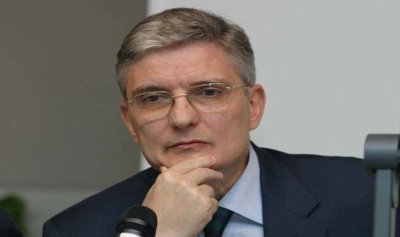
Sursă foto: stiripesurse.ro
Distribuie articolul


Distribuie articolul

Articole Similare

9
ANAR: Completing Mihaileni accumulation remains strategic objective for protecting communities in Hunedoara County
9

12
AEP: Political parties receive over RON 15.4 million in state subsidies in February
12
13
JusMin Marinescu holds meeting with British Ambassador Portam
13

18
ICR: Writer Ana Blandiana on major tour of France - Lyon, Marseille, Aix-en-Provence, Strasbourg and Paris
18
20
EconMin Darau participates in COMPET meeting in Brussels
20

31
Bucharest to host AI & Big Data Conference - Regional AI Valley
31

24
Euro trades at RON 5.0953
24

12
529 companies and sole traders enter insolvency in January 2026
12

20
Photovoltaic park to be built near Henri Coanda Airport on European funds
20

30
Drone shot down near Romanian border amid war in Ukraine
30

25
Albita PTF border police discover cartridges hidden in a bag of sweets on a coach to Italy
25
13
January 2026 general consolidated budget execution ends with 0.04pct of GDP surplus
13

12
Authorities issue 7.8% fewer building permits in January
12














Comentează