



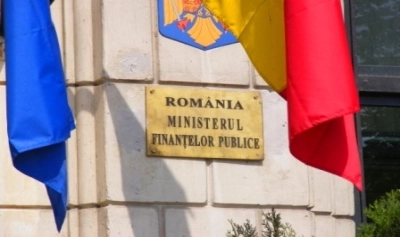
The economic activity in Romania will see a severe drop in the second quarter of this year, by 14.4 per cent, while the impact on the manufacturing industry in the mentioned period will be about 18 per cent, and the decline in manufacturing textiles and clothing, leather, and also in the automotive industry will exceed 35 per cent, according to the 2020 Convergence Programme published by the Ministry of Public Finance (MFP).
"The forecast of gross domestic product for 2020 took into account the effects of the COVID-19 pandemic, as well as support measures for the business environment, the labour market and consumers, but also interventions in the medical field. Estimates point to a severe drop in the economic activity in the second quarter of the year (by 14.4 per cent), the quarterly profile showing a predominantly "V" -shaped development, but without a return to the situation back in the winter (absence of coronavirus), and with an actual recovery to happen in the fourth quarter. The scenario is based on a negative economic impact limited in time, around 4 months (March-June), following a partial expansion in July-September, starting from the experience of China, which showed signs of recovery after 4 months.
The likely impact on the manufacturing industry in the three most affected months (March-May) will be a reduction of about 18 per cent compared with the corresponding period in 2019, with a sharper decline, exceeding 35 per cent, in the manufacture of textiles and clothing, leather and automotive industry.
During the peak period of the pandemic, services will have a negative contribution of 9.3 percentage points to the GDP dynamics, followed by industry (-3.9 percentage points). The services will be impacted especially on the segments of real estate transactions, hotels and restaurants, recreational activities, transports, maintenance services.
"Favourable macroeconomic conditions will continue to operate, especially in the third quarter, given that foreign markets will not be lost and the economy has the potential to recover through government revenue-saving measures and restarting measures (the advantageous lending of SMEs), so that reversible factors will prevail over irreversible ones," it is shown in the convergence program.
In this context, the Romanian economy is expected to register a reduction of 1.9 per cent annually, in real terms, being the result of negative contributions from both domestic demand (-1.6 percentage points) and net exports, but to a lesser extent (-0.3 percentage points). Thus, the slowdown of the mentioned sectoral indicators led to the revision of the GDP dynamics in the coronavirus scenario by about 6 percentage points, respectively from + 4.1 per cent in the winter forecast.
Convergence proigramme for 2020: Economic activity expected to show serious drop in Q2 (-14.4pct)
Sursă foto: stiripesurse.ro
Distribuie articolul


Distribuie articolul

Articole Similare

8
ANAR: Completing Mihaileni accumulation remains strategic objective for protecting communities in Hunedoara County
8

10
AEP: Political parties receive over RON 15.4 million in state subsidies in February
10

12
JusMin Marinescu holds meeting with British Ambassador Portam
12

18
ICR: Writer Ana Blandiana on major tour of France - Lyon, Marseille, Aix-en-Provence, Strasbourg and Paris
18

19
EconMin Darau participates in COMPET meeting in Brussels
19

28
Bucharest to host AI & Big Data Conference - Regional AI Valley
28

22
Euro trades at RON 5.0953
22

11
529 companies and sole traders enter insolvency in January 2026
11

19
Photovoltaic park to be built near Henri Coanda Airport on European funds
19

29
Drone shot down near Romanian border amid war in Ukraine
29

23
Albita PTF border police discover cartridges hidden in a bag of sweets on a coach to Italy
23
12
January 2026 general consolidated budget execution ends with 0.04pct of GDP surplus
12

11
Authorities issue 7.8% fewer building permits in January
11












Comentează