



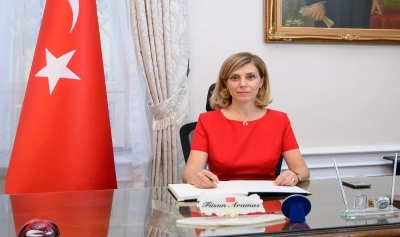


The Republic of Turkey celebrates its 98th anniversary today. This happy occasion encourages us to have an overview of the Republic’s diplomacy, its evolution throughout a century-long journey, as well as the guidelines of the Turkish-Romanian relations as a distinct example of versatile regional collaboration at a critical geopolitical crossroads.
The birth of modern Turkey was the manifestation of a new era in international relations after World War I. The end of empires and the birth of nation states all over Europe entailed efforts among the international community to explore new ways of governance. The appearance of the Republic of Turkey in world diplomacy represented the concrete outcome of this transition period in world affairs, coinciding with the opening of a new era.
Born from the ashes of decades-long turbulence in the Near East, the young Turkish Republic proclaimed itself as a new actor by the Lausanne Treaty of 1923. The Republic established an effective diplomacy built on firm grounds which would pave the way for young Turkey to reclaim her esteemed place among the family of world nations. With this understanding, Turkey adopted a proactive stance on the major principles of independence, rationality and solidarity. As such, the Turkish diplomacy pursued to accommodate peace and render stability sustainable. This paradigm was epitomized in the motto announced by Kemal Atatürk “Peace at Home, Peace in the World”.
The projection of this policy on the regional dimension brought forward exemplary initiatives in the South East of Europe and the Middle East. In a period of turmoil where aggression and irredentism accelerated all over the world, Turkey took important steps to ensure security and cooperation in the West and East at a time when the World War II was looming. Romania assumed a key role in Turkish diplomacy in this period. Joint efforts by the founding fathers of Turkey and Romania generated the Balkan Entente in 1934, an early model of contemporary regional ownership.
The multilateral and cooperative nature of the Turkish foreign policy continued to shape Turkey’s relations during and after the Cold War. Taking its place in the transatlantic link, Turkey joined NATO and stood out among the founding members of the Council of Europe and the Organization for Security and Cooperation in Europe. Post-1991 witnessed re-calibration of Turkey’s assets and tradition for engagement with the world through a 360-degree angle.

The peace motto of Turkish diplomacy in early years of the Republic remains the guiding principle of Turkish foreign policy today. Aligning its primary codes with the contemporary needs and realities, Turkey resorts to her soft power capacity, creating an upgraded narrative with multiple dimensions. We employ multilateral platforms for dialogue and mediation and as means to further our policy and maintain our global outreach. The annual Istanbul Mediation Conference series, and the Antalya Diplomacy Forum (ADF) are two major initiatives in this regard. Minister Bogdan Aurescu participated as a panelist in this year’s ADF.
In consistence with prioritizing cooperation and solidarity in multilateral platforms, Turkey pursues a humanitarian foreign policy. Among the various facets we pioneer in this regard, concerns about the phenomenon of irregular migration and immigrants occupy an exceptional chapter. Under the spotlight of global community, Turkey hosts the largest number of externally displaced people in the world. Out of an approximate 4 million EDPs whom Turkey accommodates on its own territory, 3.7 million Syrians constitute more than ninety per cent. Turkey’s embrace to these innocent civilians is not limited to the shelter provided, but it entails a whole set of services in accommodation, education and health.
Adopting the basic principle of regional ownership, regional formats are modern manifestations of our historic commitment to solidarity. The Black Sea Economic Cooperation (BSEC) and the South East European Cooperation Process (SEECP) are major concrete platforms Turkey paved the way for. Our distinct cohesion in BSEC and the SEECP serves to the collective good in the larger South East Europe and Black Sea basin, maintaining the constructive role we assumed in last century for our common region.
Turkey and Romania celebrate the 10th anniversary of their Strategic Partnership this year. Our ever-growing relations and collaboration in almost every field exhibit an exceptional portrait.
As of 2021, Turkey and Romania are the largest commercial partners in South East Europe, with a mutual trade volume of around USD 7 billion. With Turkish entrepreneurs from a multitude of different sectors being among the primary group that perceived and promoted the significance of Romania as a new partner with a promising potential after 1989, Turkish investments have already surpassed the level of USD 7 billion, putting Turkey among the largest foreign investors after the USA and the EU. These figures give Romania the lead among Turkey’s economic partners in Central and Eastern Europe. Turkish entrepreneurs have made Romania their second home and represent a well-integrated group of expats in the country.
The presence of the Turkish-Tatar minority in Romania sets the major component of humanitarian aspect in close friendship and good neighbourly relations between our countries. The Turkish-Tatar community enjoy their rights granted by the Constitution and well inclusive policies of Romania through the Dobrogea model.
With our tradition of solidarity for regional stability translated into our joint vision and Alliance under the NATO umbrella, we traject a security dialogue to a wide nexus in the Alliance through the Turkey-Romania-Poland Trilateral Mechanism.
The Trilateral Mechanism has already completed 9 years and 7 Foreign Ministerial Meetings. We will celebrate its tenth anniversary in 2022. It has brought forth an extension to the level of Trilateral National Security Advisors in August 2021, which will continue in the years ahead to strengthen our common ground. The Mechanism has provided us with the opportunity to oversee and assess developments that concern transatlantic security from Baltics to Black Sea, trajecting a broad area from Balkans to the Caucasus.
This year’s Ministerial edition was held in Bucharest on 22-23 April 2021, was crowned by the bilateral dimension. Ministers Aurescu and Çavuşoğlu marked the 10th Anniversary of the Turkish-Romanian Strategic Partnership, by way of a thematic conference which they launched together. The visit of Turkish Minister of National Defence, Mr. Hulusi Akar to Romania on 8-9 March was also an integral part of our celebrations.
The takeover of the NATO Very High Readiness Joint Task Force (VJTF) Command by the Turkish Armed Forces as of January 2021 complemented these visits. The Turkish Land Forces commanded the Multinational exercise of Steadfast Defender 21, held on Romanian territory in May 2021. It set a thorough manifestation of our Alliance and good neighbourly relations.
The birth of the modern Turkish Republic sealed the everlasting friendship and solidarity between Turkish and Romanian peoples. Turkish and Romanian diplomacies maintained this momentum throughout the 20th century. We have transformed this mutual will into a synergy to the benefit of our two nations and beyond. On its 98th anniversary, the Republic of Turkey is determined to elevate this valuable friendship to newer heights.
























Comentează