



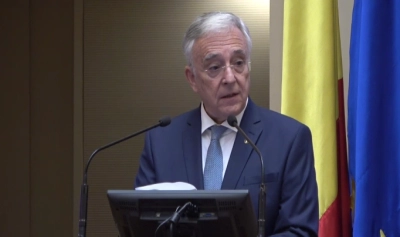
Governor of the National Bank of Romania (BNR) on Friday commended the government's maintaining the budget deficit below the 3 pct reference level, which kept the GDP share of the public debt below 40 percent, but cautioned that with economic growth as high as Romania's in 2017 "one should seek to stay below this limit."
"I welcomed the fact that the government has kept the deficit below the 3 percent benchmark, which has maintained the government debt's GDP share below 40 pct. As you know, the critical level in the EU is 60 pct, but for emerging countries like Romania 40 - 45 percent is considered to be critical. The fact that we keep the public debt below 40 pct is positive, but a less positive aspect is that this 3 percent occurs against an extremely high economic growth - both in relative and historical terms - therefore the structural deficit, as calculated, is a less visible parameter, so to speak, but economists calculate it though, and it has shot up from 2.2 pct to over 3 pct, and it is sensibly superior to the medium term target of 1 percent. We, the National Bank, hope we don't preach in vain when we insist that fiscal policy should not be pro-cyclical. It has to when you have such economic growth, you should not stay at the 3 percent deficit limit, but try to position yourself below," Mugur Isarescu told the conference for the presentation of the Report on inflation.
According to him, the rise in the 2017 structural deficit was also accompanied by an unfavorable structure of public investment. Consequently, short-term and strategic long-term interests are in an unfavorable relation.
There is need for more substantial growth in public investment because it is an essential factor for long-term economic development, Isarescu said.
The BNR governor also cautioned against the widening of the unfavorable gap between the imports and exports' growth rate (12 pct vs. 9 pct, respectively), as the monthly trade deficit has frequently exceeded 1 billion euro in H2, as well as against the delayed resumption of funding from structural and investment European funds, with an absorption rate of just 10 percent under the current financial programming period (2014 - 2020).
On top of that, the number of employees in the labor market hit an all-time high of 4.8 million, but despite that there are persistent structural deficiencies and a 33 percent inactivity rate (placing Romania 3rd in the EU), a high share of young people who are not participating in any activity (20 pct), limited internal mobility and a serious inconsistency of training with market requirements.
BNR governor: With so high economic growth, budget deficit should be kept below 3 pct limit
Sursă foto: captura TV
Distribuie articolul


Distribuie articolul

Explorează subiectul

București 7°C
7°C
7°CArticole Similare

18
Bucharest Stock Exchange closes higher Wednesday's trading session
18
13
National Order "Star of Romania" - awarded to Pierre Moscovici, member of European Court of Auditors
13

23
Justice Minister says decision in Pfizer vaccine case not final, but enforceable
23

13
Voineasa ski slopes, open on Easter too
13

14
Almost everyone who spoke at PSD's Bucharest-Ilfov regional meeting demanded we move into opposition (Grindeanu)
14
15
PM Bolojan: The Pesach holiday is about dignity, responsibility and respect, values that concern us all
15

13
Romanian, Ukrainian companies meet to develop drone projects
13

10
Ministry of Finance proposes package of measures to modernize system of electronic fiscal cash registers
10

13
Stroe (PNL): The new law to combat violence during sports games, an alignment with modern standards
13

7
Department for Romanians Abroad launches 2026 non-reimbursable financing session
7

10
Grindeanu: My colleagues told me that they no longer want us to continue in this form
10
12
Partnership with U.S. remains fundamental pillar for Romania's stability, economic development (minister)
12

10
Romania is the most successful country in terms of EU convergence (minister)
10















Comentează