



The average speed of freight trains in Romania is of 16 km / h, and the transit between Constanta (southeast) and Curtici (west) takes between 7 and 12 days, based on the quantity transported, reveal the conclusions of a study done by the Railway National Surveillance Council (CNSDF), within the Competition Council, sent to AGERPRES on Monday.
Following the analysis it is shown that although the Romanian freight transport market is competitive, the profitability of such an activity is reduced. This aspect is also confirmed by the fact that the share of railway transport in Romania, in total transportation methods, was of 12%, while road transport held a share of 68%.
The slowed railway running speed and the favoring of the road transport, by refunding the excise on fuel to road transporters of goods, determined a drop in profitability for railway freight transport, when comparing with road transport.
Under these conditions, railway operators' interest dropped for renewing the rolling stock park, but also dropped the interest of potential investors in the railway infrastructure, especially regarding the development of the freight terminals.
In the year 2020, under the conditions generated by the SARS-CoV-2 pandemic, railway traffic of goods has gone down by 6.6% and the number of freight trains placed into circulation has dropped by 15.4% from the previous year. At the same time, freight quantity transported via train, expressed in net tons/km, has gone down by 14.7%, and the income of railway operators registered a slash of 13.7%, the CNSDF study shows.
The main railway operators, form the standpoint of income done by railway freight transportation are: CFR Marfa, Grup Feroviar Roman, Deutsche Bahn Cargo and Unicom Tranzit, and from the standpoint of the distance indicator of trains (trains/km) in national and international freight transport, CFR Marfa and Grup Feroviar Roman are the most important competitors.
The main goods transported via railway are oil products and derivatives, cereal, construction material and raw material (ore, coal, logs, fertilizers).
In order to achieve the connection with the central TEN-T network (the Trans-European Transport Network), the projects for electrifying and retrofitting the infrastructure of the two European Freight Railway Corridors which cross Romania need to be established: the Orient freight railway corridor / EastMediteranean and the Rhine - Danube railway corridor.
A freight train crosses country, East-West, from Constanta to Curtici, in 7-12 days
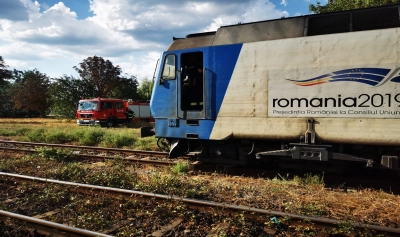
Sursă foto: Foto Mediafax
Distribuie articolul


Distribuie articolul


București 9°C
9°C
9°CArticole Similare

19
ForMin Toiu reiterates Romania's support for Ukraine at informal meeting of Foreign Affairs Council in Kiev
19

10
“Family Footprints”: Students from Four Countries Explore Family Values through an eTwinning Project
10

11
Gov't approves memorandum for signing of EU-Mercosur Partnership Agreement
11

13
Customs authority, anti-corruption directorate sign collaboration protocol
13

18
EnerMin Ivan:Romania was attacked by Russian Federation 17 times in history, USA has always been an ally
18

10
Government: Capping of markup for basic foods extended until June 30
10
17
Hidroelectrica's Badea: Hydroelectric power plants are not sufficiently backed in Europe
17

11
Andrei (INS): There are controversies over gov't because data are not well understood
11

15
EnergyMin Ivan says decision to cut excise duty on diesel fuel must be made this week
15
19
Ivan, on leaving government: Decision belongs to the 5,000 colleagues in PSD
19
11
Energy crisis puts major pressure on ANRE; over 20 billion RON settled for compensation(secretary general)
11

14
Nicusor Dan: Romania still needs to develop transport infrastructure
14

13
Almost two-thirds of Romanian retail investors do not trust the prospects of the local economy (report)
13














Comentează